Best Korean Food Tours in Seoul (2026): Markets & BBQ
Korean food tours in Seoul ranked: Gwangjang market, kimchi cooking class, halal & vegetarian picks. English guides, instant booking, dietary flags.
Korean food is a top reason to visit Seoul. Seven hand-picked food tours from MyRealTrip — markets, cooking classes, halal walks — with English support and dietary flags.
This guide goes deeper than pick #6 of our Best Things to Do in Seoul ranking for 2026. If you’ve already decided you want a guided Korean food experience and just need to pick which kind, you’re in the right place.
TL;DR — Quick pick by traveler type
Five common food-traveler personas, five default picks. Read the full sections before booking.
| You are | First pick | Why it works |
|---|---|---|
| Foodie traveler stacking 2-3 food experiences | #1 K-Food Private & Custom Tour | Customizable English-guided private day — fold market + cooking demo + BBQ dinner into one booking |
| K-content fan (Mukbang / K-drama scenes) | #5 Han River Street Food + Night Picnic | The Crash Landing on You chimaek + skyline scene, made bookable |
| Couple wanting a Korean BBQ + soju night | #6 Jongno Pojangmacha + Ikseondong | The closest substitute in current inventory — see “Honest gaps” before booking |
| Cooking class enthusiast (kimchi was the goal) | #3 Makgeolli + Traditional Appetizer Class | Strongest cooking-class reviews; #4 is the rotating-menu kimchi alternative |
| Solo traveler easing into Korean cuisine | #2 English Gwangjang Market Food Tour | Small group, English-only narration, the iconic Korean market in 2-3 hours |
Across the seven picks, the average rating sits at 4.96 / 5.0 across the four picks with review history — but the total review base is just 24 reviews combined. That’s a structural inventory reality, not a quality problem. The “How we picked” section below explains how we leaned on EEAT signals instead of pretending the review pool is bigger than it is. Prices and availability subject to change.
Why book a guided Korean food tour?
Four reasons most first-time travelers end up booking one even after eating Korean food at home.
Menu-language friction. Korean menus are romanized but rarely translated. “양념 막창” tells you nothing if you can’t read Hangul, and even “yangnyeom makchang” is opaque if you don’t know that’s marinated grilled large intestine. A guide who reads the menu and explains the cuts is worth the price.
Etiquette anxiety, especially BBQ. Korean BBQ is a group cuisine — soju-pour rituals (two hands, never your own glass), the question of who grills, banchan refill etiquette, the chimaek/somaek culture once soju is flowing. Most travelers prefer to learn by being shown, not by Googling at the table.
K-content discovery wedge. Travelers chasing specific scenes — the Crash Landing on You Han River chimaek picnic, the Squid Game dalgona, every K-drama set in a pojangmacha tent — want a guide who knows which Mukbang creator filmed at which Gwangjang stall.
Dietary navigation. Vegetarian Korean food requires knowing which dishes use anchovy stock and which kimchi has fish sauce. Halal clusters in Itaewon’s Islamic Street. Allergy-safe Korean food needs a guide who can ask the kitchen the right questions in Korean. The dietary section below covers phrases you can copy for non-tour meals too.
Which experience type should you pick?
Korean food in Seoul splits across roughly five experience types.
Market crawl — Gwangjang Market is the canonical answer (pick #2). Bindaetteok, mayak gimbap, tteokbokki, jeon, sundae. Two to three hours. Other major markets (Tongin, Mangwon, Namdaemun) don’t currently have English-language food tours; pick #1 can route through them as a custom configuration.
Cooking class — picks #3 (makgeolli + traditional appetizers, alcohol-paired) and #4 (Korean cooking class one-day, rotating menu, no alcohol). The standalone kimchi-making class is not currently bookable from Seoul on MyRealTrip — see “Honest gaps” below.
Korean BBQ + soju nightlife — the structural gap. No dedicated Korean BBQ tour exists in current inventory. Pick #6 (Jongno Pojangmacha + Ikseondong) is the closest cultural substitute — Korean tent-bar drinking culture with soju and traditional snacks. For a literal Korean BBQ focus, configure pick #1.
Street food / nightlife — pick #5 (Han River Street Food + Night Picnic) for the K-drama chimaek scene; pick #6 (Jongno Pojangmacha) for the tent-bar nightlife.
Dietary-friendly walks — pick #7 (Itaewon Islamic Street) is the only halal-explicit food walking tour. Vegetarian travelers also do well there because Middle-Eastern cuisine has stronger vegetarian traditions than most Korean restaurant chains.
A balanced 4-day food itinerary: morning market tour day 1 (#2), evening Han River picnic day 2 (#5), afternoon cooking class day 3 (#3 or #4), pojangmacha night day 4 (#6).
How we picked these seven
Rating cutoff: 4.6+ where any rating exists. Five of our seven picks are 4.8 or 5.0; three (picks #2, #5, #6) are newly listed with zero reviews and flagged transparently rather than padded.
Review-count reality check. Across the seven picks, total reviews come to 24 — much smaller than our 1,100+ DMZ shortlist. This is a structural inventory situation: MyRealTrip’s Seoul Korean-food category is mostly post-2025 listings still accruing reviews. The few products with hundreds of reviews are either premium combo tours we already used in the parent ranking or non-Korea products that surfaced under noisy keyword searches. We applied the niche-exception clause and leaned on EEAT — English-explicit branding, MyRealTrip’s licensed-operator moat, dietary-accommodation transparency — rather than pretend the social-proof base is bigger than it is.
English-friendliness honestly assessed. Two picks (#1 and #2) are sold under explicit English-only branding. The others are inferable from Seoul-TNA inbound-tourist framing — confirm narration language on the booking page before paying.
Dietary accommodation as a first-class filter. Every pick carries a vegetarian flag, plus a halal flag and an alcohol-included flag. Pick #7 is the explicit halal anchor; pick #4 (no alcohol) and pick #1 (configurable) cover non-drinkers and Muslim travelers. Most aggregator listings bury this in product descriptions.
Local-operator moat. Every pick is from a Seoul-licensed local Korean operator via MyRealTrip’s direct partner inventory. Klook and Viator largely resell wholesale; MyRealTrip lists food writers, chefs, and licensed walking-tour operators directly.
Honest disclosure: we earn a commission on bookings made through these links. We excluded products that didn’t clear the rating threshold regardless of payout. The cutoff is the cutoff.
The Food Experience Matrix
This is the page’s hero asset — a single-look comparison across nine columns no aggregator surfaces upfront.
| Tour | Type | Neighborhood | Duration | English | Vegetarian | Halal | Alcohol | Price | Rating |
|---|---|---|---|---|---|---|---|---|---|
| #1 K-Food Private Custom | Custom | Configurable | ½–full day | Explicit | Adaptable | Adaptable | Optional | Mid (~KRW 90K) | 5.0 / 3 |
| #2 English Gwangjang Market | Market crawl | Gwangjang | 2–3 hr | Explicit | Partial | Partial | Optional | Mid (~KRW 90K) | New (0) |
| #3 Makgeolli + Appetizer Class | Cooking class | Seoul | 2–3 hr | Inferable | Partial | No (alcohol) | Yes | Mid (~KRW 65K) | 4.8 / 19 |
| #4 Korean Cooking Class One-Day | Cooking class | Seoul | 2–3 hr | Inferable | Adaptable | Adaptable | No | Value (~KRW 45K) | 5.0 / 1 |
| #5 Han River Night Picnic | Street / nightlife | Han River parks | 2–3 hr | Inferable | Partial | Partial | Optional | Mid (~KRW 60K) | New (0) |
| #6 Jongno Pojangmacha + Ikseondong | Street / nightlife | Jongno + Ikseondong | 2–3 hr | Inferable | Partial | No | Yes | Mid (~KRW 70K) | New (0) |
| #7 Itaewon Islamic Street Halal Walk | Halal walking tour | Itaewon | 2–3 hr | Inferable | Yes | Explicit | No | Value (~KRW 50K) | 5.0 / 1 |
Read across, not down. Filter by your hard constraints first (English requirement, dietary need, alcohol preference), then rank by persona fit. The two English-explicit picks are #1 and #2; the only “yes” vegetarian and only “explicit” halal pick is #7; the alcohol-free picks are #4 and #7; the alcohol-included picks are #3 and #6.
Vegetarian, halal & dietary Korean food in Seoul
The single biggest underserved query in this category is “vegetarian Korean food tour Seoul” (and its halal sibling). Most competitor articles skip it.
Vegetarian Korean food, the reality. Korean cuisine is more vegetable-forward than most travelers realize — banchan side dishes are mostly vegetable, kimchi is primarily cabbage, japchae and bibimbap have vegetarian variants, sundubu jjigae is regularly made vegetarian on request. The catches are stock and condiments. Many soup bases use anchovy or beef stock; many kimchi recipes use fish sauce (액젓); shrimp paste sneaks into stews. The fix is asking about stock and substitutions before ordering — a Korean-speaking guide on picks #1, #4, or #7 makes this trivial.
Useful phrases for non-tour meals (copy these onto your phone):
- 채식이에요 (“chae-shik-i-eh-yo”) — I’m vegetarian
- 비건이에요 (“vee-gun-i-eh-yo”) — I’m vegan
- 고기 빼주세요 (“go-gi pae-ju-seh-yo”) — please leave out the meat
- 새우 빼주세요 (“sae-woo pae-ju-seh-yo”) — please leave out the shrimp
- 멸치 육수 안 들어간 거 있어요? (“myul-chi yook-soo an deul-eo-gan geo iss-eo-yo”) — anything without anchovy stock?
Halal in Seoul. Halal-certified restaurants cluster in Itaewon, particularly along the Islamic Street stretch near Seoul Central Mosque. Pick #7 walks this exact neighborhood. Outside Itaewon, halal options are sparser; pick #1 (private custom) configured with a halal-Korean-restaurants focus is the next-best Korean-food-focused answer. Pick #4 (cooking class, alcohol-free) is the halal-adaptable cooking class option.
Vegan adaptation. Vegan Korean is harder than vegetarian, mainly because most kimchi contains fish sauce and most banchan touches a fermented seafood somewhere. Temple cuisine (사찰음식, sachal eumsik) is the exception — Korean Buddhist monastic food is fully vegan by tradition. Pick #1 (custom) can route through a temple cuisine restaurant if requested at booking.
Allergies. The most common Korean cuisine allergens are shellfish, peanut, gluten (soy sauce and gochujang are wheat-based unless specified), and dairy. Disclose all allergies in writing through MyRealTrip’s English customer support before booking, not on the morning of the tour.
Korean BBQ + soju etiquette demystifier
Even though MyRealTrip’s current Seoul inventory doesn’t have a dedicated Korean BBQ + soju tour, you’ll likely end up at a BBQ restaurant during your trip. Here’s the demystifier.
Who grills the meat. Varies by venue. At higher-end places, staff grill for you and cut the meat with scissors. At casual neighborhood places, the youngest at the table or the host grills for the group. As a foreign visitor at a casual place, you can ask a staff member to start the first round; after that, anyone in the group can take over.
What’s free, what’s paid. Banchan (the small side dishes — kimchi, pickled radish, bean sprouts) are free and refillable. Ask politely: “더 주세요” (deo ju-seh-yo, “more please”). Lettuce wraps and ssam vegetables are usually free with grilled meat orders. Rice and stews are paid. Soju and beer are paid.
Soju pour etiquette. Three rules. First, never pour your own glass — hold up your glass and someone else will pour. Second, pour with two hands for elders or hosts — right hand on the bottle, left hand supporting the right wrist. Third, receive with two hands and turn slightly away to drink when drinking with someone older or higher in social rank.
The bomb-shot question (폭탄주 / somaek). Somaek is soju mixed into beer — the standard Korean drinking-night escalation. You can decline politely: “저는 술 잘 못 마셔요” (I can’t drink much). Korean drinking culture has changed in the last decade, and refusing alcohol is more accepted than it used to be.
Chimaek (치맥). Chicken (chi-kin) + maekju (beer). Korean fried chicken with cold beer, usually after work or on summer evenings. Han River parks (pick #5) and Hongdae alleys are the canonical settings. Casual format — order at the counter, find a spot, eat with hands or chopsticks.
Pojangmacha (포장마차). Tent bars on Seoul’s streets, mainly active 6 pm to 2 am. Sit at the communal table, order soju + a couple of side snacks (anju), pay before you leave, don’t linger after you’ve finished.
Tipping. Don’t. Korea is not a tipping culture. The one common exception is private tour guides on multi-hour custom tours — optional, not expected.
The 7 picks
1. K-Food Private & Custom Tour: Build Your Own Seoul Food Day (English-Guided)
![[English] 한국 음식 맞춤여행 (K-Food private & custom tour)](https://dry7pvlp22cox.cloudfront.net/mrt-images-prod/2024/11/27/7CWG/kLs2AJJKAT.jpg?width=480&quality=70)
[English] 한국 음식 맞춤여행 (K-Food private & custom tour)
An English-explicit private custom Korean food tour, configurable across market crawl, cooking demo, BBQ dinner, and street food. The flagship foodie pick — and the dietary-accommodation default for vegetarian, halal, and alcohol-free travelers.
- ·Explicit English-only branding — the highest-trust English-narration pick on our list
- ·Fully customizable across market / BBQ / cooking class / street food in a single booking
- ·Private format = vegetarian, halal, allergy, and alcohol-free adaptations are simple booking requests
- ·Solves the BBQ-tour gap (configure with BBQ + etiquette focus) and the kimchi gap (configure with kimchi-making segment)
- ·Small review pool: 5.0 / 3 — newly listed custom format. Layer in a higher-volume daytime pick if review volume matters
- ·Configurable scope means the price moves with what you add — base is mid-range, BBQ-dinner add-ons push it higher
Best for: Foodies stitching together a multi-experience day, solo travelers who’d rather not navigate Korean menus alone, and any traveler whose dietary needs make group tours fragile.
What you’ll experience: A configurable private day with an English-speaking Korean food guide. The base format is a half-day around Gwangjang Market or Insadong; the configurable add-ons stretch the day across BBQ, cooking class, dessert, or pojangmacha nightlife. The guide handles menu translation, ordering, and dietary substitutions.
Why English-explicit matters: This is the only pick on our list with explicit English-only branding and private-custom-tour flexibility — pick #2 is also English-explicit but follows a fixed Gwangjang route.
The BBQ workaround: As covered in “Honest gaps” below, no dedicated Korean BBQ tour currently exists on MyRealTrip. The intended workaround is to book this pick configured as “Korean BBQ dinner + etiquette walkthrough + post-meal pojangmacha or chimaek” — message the operator at booking with this exact request.
The kimchi workaround: Pick #4 is the closest substitute for a standalone kimchi-making class. If kimchi is your specific priority and you want certainty, configure this pick with “kimchi-making demo + traditional Korean lunch.”
Honest cons: Three reviews is a small pool. The price moves with configuration; KRW 90,000 is the base bracket, BBQ-dinner adds push it higher.
Pairs well with: A morning DMZ trip (see our DMZ guide) ends in mid-afternoon — book this as the evening Korean food day-cap.
2. English-Guided Gwangjang Market Korean Street Food Tour
![[영어 투어] 광장 전통시장 길거리 음식 탐방](https://dry7pvlp22cox.cloudfront.net/mrt-images-prod/2025/03/07/vkZB/NzSQILpnXc.png?width=480&quality=70)
[영어 투어] 광장 전통시장 길거리 음식 탐방
The canonical Gwangjang Market food crawl with English-only narration — bindaetteok, mayak gimbap, tteokbokki, jeon. The Netflix Street Food: Asia angle, made bookable for non-Korean speakers.
- ·Explicit English-only narration — the only English-language Gwangjang tour on MyRealTrip
- ·Iconic market: Netflix Street Food: Asia featured Gwangjang for a reason
- ·Small group format — solo-friendly, no third-wheeling
- ·Vegetarian-adaptable for most stops (skip meat-heavy stalls)
- ·No reviews yet — newly listed. Pick #1 has 5.0/3 if review volume matters
- ·Vegetarian flag is 'partial' — yukhoe and meat jeon are off-limits; menus rotate seasonally
Best for: Foodies on their first Seoul food crawl, K-content fans who want the Netflix Street Food angle, and solo travelers who’d rather not navigate Gwangjang’s rapid-fire stall culture alone.
What you’ll experience: A 2-3 hour walking food crawl through Gwangjang Market in central Seoul. Stops typically include bindaetteok (the iconic Gwangjang dish — mung-bean pancakes fried in pork-fat-laced oil), mayak gimbap (literally “drug” gimbap — bite-sized rice rolls so addictive they earned the name), tteokbokki (spicy stir-fried rice cakes), jeon (savory pancakes), and depending on operator, soondae (Korean blood sausage with offal) and yukhoe (Korean steak tartare). A pojangmacha-style soju moment usually closes evening departures.
The Netflix Street Food: Asia angle: The Gwangjang Market episode put Gwangjang on the global travel map after 2019. We’re not claiming the operator is the one Netflix profiled — we’re saying this is the market that episode is about.
English-only narration: The only English-language Gwangjang Market food tour in MyRealTrip’s current Seoul inventory. Most Klook and Viator listings for “Gwangjang Market food tour” are wholesale-resold Korean tours where the English version is a translation afterthought. This product is sold as English-only.
Vegetarian reality: Roughly 60% of Gwangjang’s iconic stops have vegetarian options. Bindaetteok is vegetarian by default (the pork-fat oil is the contested item). Mayak gimbap is vegetarian if you order the non-tuna variant. Vegetable tteokbokki, vegetable jeon, kimbap, and dumplings are available. Off-limits: yukhoe, meat jeon, sundae. Tell the operator vegetarian at booking.
Honest cons: Zero reviews — we surfaced this product because there is no other English-language Gwangjang Market food tour and “Gwangjang Market food tour” is the highest-volume Korean food query for inbound travelers. “Partial” vegetarian — Gwangjang’s menu is heavily meat-and-seafood-tilted.
Pairs well with: A morning Gyeongbokgung walking tour or hanbok rental (covered in our parent Seoul ranking) — eat lunch at Gwangjang, then nap the afternoon away before evening pojangmacha.
3. Makgeolli Brewing & Traditional Korean Appetizers Class in Seoul
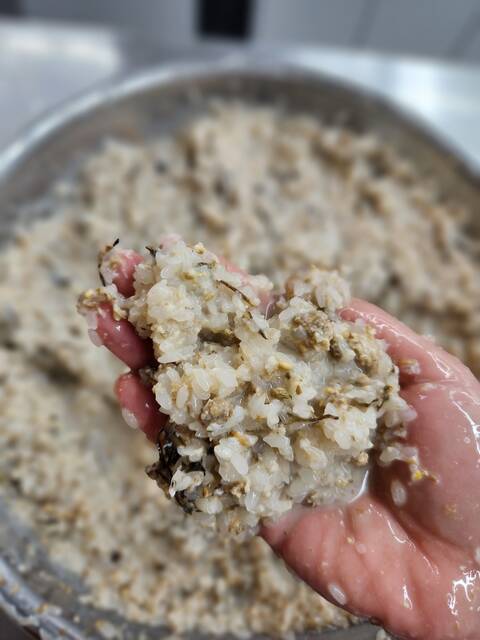
나만의 막걸리와 맛있는 전통안주 만들기 (대한민국/서울)
Hands-on makgeolli (Korean rice wine) brewing plus traditional anju side dishes. The strongest cooking-class review base in MyRealTrip's Seoul Korean-food inventory.
- ·Strongest cooking-class reviews in our shortlist: 4.8 across 19 reviews
- ·Hands-on makgeolli brewing — pedagogically rich (rice prep, nuruk yeast culture, fermentation)
- ·Traditional anju (Korean drinking snacks) included
- ·Take-home bottle typical for makgeolli classes — confirm at booking
- ·Alcohol-centric — not for non-drinkers, Muslim travelers, or pregnant women. Default to pick #4 instead
- ·English support inferable, not explicit — confirm narration on booking page
- ·Halal: not compliant due to alcohol focus
Best for: Cooking class enthusiasts who want a higher-craft Korean experience than a generic dish-cooking class, and foodies layering a traditional Korean beverage angle into their itinerary.
What you’ll experience: A 2-3 hour hands-on class. You’ll prep rice (steamed and cooled to fermentation temperature), inoculate it with nuruk (the traditional Korean yeast culture), and start your own makgeolli batch. While the brew rests, you’ll prepare two or three traditional anju — typical rotation includes vegetable jeon, kimchi-pancake variants, and seasonal pickled banchan. The class wraps with a tasting paired with the anju you made. Operators typically send students home with a sealed bottle of their brew (confirm at booking).
Why makgeolli specifically: Makgeolli is Korea’s oldest still-popular alcoholic beverage — a slightly fizzy, milky-white rice wine that was the farmer/working-class drink for centuries before soju overtook it in the 20th century. Brewing a batch yourself is partly a cooking lesson, partly a Korean-history primer.
The 4.8/19 review caveat: Nineteen reviews is below our standard 50-review floor, but it’s the strongest review base in the entire Korean cooking-class subset of MyRealTrip Seoul inventory.
Alcohol-centric flag: Non-drinkers, pregnant travelers, and Muslim travelers should default to pick #4 (Korean cooking class one-day, alcohol-free) instead.
Pairs well with: Pick #6 (pojangmacha + Ikseondong) the same evening — you’ll have learned the makgeolli-brewing context and can taste the bar version a few hours later in tent format.
4. Korean Cooking Class One-Day: Hands-On Korean Dishes (Rotating Menu)
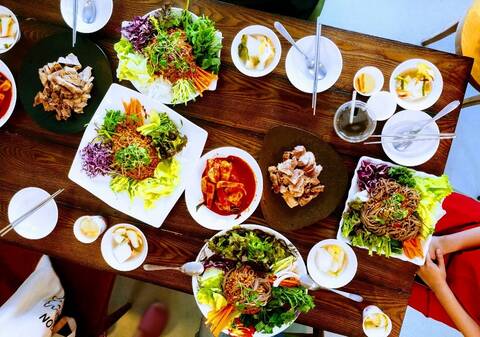
원데이 쿠킹클래스 한식 (대한민국/서울)
A value-tier Korean cooking class with a rotating menu — kimchi, bibimbap, japchae, tteokbokki. The closest substitute for a standalone kimchi-making class, plus the alcohol-free alternative to pick #3.
- ·Lowest-priced cooking class — value bracket entry at KRW 45,000
- ·Alcohol-free — Muslim, non-drinker, pregnant traveler safe
- ·Rotating menu often includes kimchi — closest substitute for the requested standalone kimchi-making class
- ·Vegetarian and halal substitutions adaptable on request
- ·Confirm kimchi day at booking — menu rotates and kimchi isn't guaranteed every session
- ·Single review (5.0/1) — newly listed, small evidence base
- ·English narration inferable, not explicit
Best for: Cooking class enthusiasts whose specific goal was kimchi-making, solo travelers wanting a no-pressure hands-on Korean experience, Muslim and non-drinking travelers locked out of pick #3’s alcohol focus, and value-conscious bookers.
What you’ll experience: A 2-3 hour hands-on Korean cooking class with a rotating menu. Typical rotation includes kimchi (cabbage or radish kimchi), bibimbap, japchae, tteokbokki, and Korean street toast. You’ll prepare the dishes yourself with the chef’s guidance — actual chopping, mixing, cooking — not a watch-and-eat demo. Take-home recipe cards are typical.
The kimchi substitute reality: A standalone kimchi-making class is not currently bookable from Seoul through MyRealTrip — we searched repeatedly under “김치 만들기,” “kimchi class Seoul,” “한식 클래스,” and no dedicated kimchi-only product surfaced. This pick is the closest substitute because its rotating menu features kimchi as a typical entry. The honest caveat: kimchi is not guaranteed on every session. Message the operator at booking with “I want a session where kimchi is on the menu” — they’ll book you onto a kimchi-day session if available.
Vegetarian and halal: Both adaptable. Bibimbap, japchae, and tteokbokki have vegetarian variants. Kimchi can be made vegan-friendly by skipping fish sauce — flag this at booking. Halal substitutions follow the same logic.
Honest cons: The single review is a thin evidence base. The rotating-menu means kimchi-day isn’t guaranteed unless you confirm at booking. English narration is inferable but not explicit.
Pairs well with: A morning Gwangjang market crawl (pick #2) — eat the iconic Korean street foods at the market, then learn to make versions of them yourself in the afternoon class.
5. Han River Street Food & Night Picnic Tour: Chimaek + Seoul Skyline
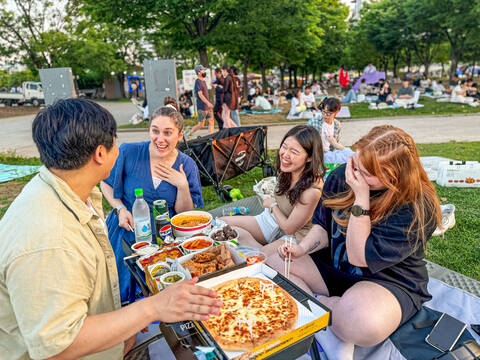
서울의 중심 한강에서 즐기는 길거리음식과 야경 피크닉
The K-drama Han River chimaek picnic, made bookable. Korean fried chicken + beer (or soft drinks if you'd prefer) by the river with the Seoul skyline lighting up. The most-photographed K-drama food scene in Seoul, in tour format.
- ·The Crash Landing on You / countless K-drama Han River chimaek scene — directly bookable
- ·Seoul skyline + river-side picnic — the highest photo-op setting on our list
- ·Alcohol-optional (soft drinks substitution available — important for Muslim, non-drinking, and family travelers)
- ·Evening departure — fits cleanly after a daytime market or palace tour
- ·No reviews yet — newly listed Han River picnic format
- ·Weather-dependent — winter departures limited; rain cancellations possible
- ·Vegetarian flag is 'partial' — chimaek is the centerpiece and it's not vegetarian
Best for: K-content fans (Crash Landing on You + every K-drama set on the Han River), couples on a Seoul date-night arc, solo travelers wanting an evening activity that meets other travelers.
What you’ll experience: A 2-3 hour evening picnic at one of the Han River parks (typically Yeouido, Banpo, or Ttukseom). The tour bundles Korean fried chicken (“chimaek” when paired with beer), ramyeon (sometimes prepared at the river-side convenience-store ramyeon machines that became K-drama landmarks), vegetable kimbap or tteokbokki sides, and the picnic-blanket setup with the Seoul skyline as backdrop. The Banpo Bridge Moonlight Rainbow Fountain (when running, typically Apr-Oct) lights up across the river — the canonical Crash Landing on You backdrop.
The K-drama angle: Han River chimaek picnics appear in dozens of K-dramas — Crash Landing on You is the most-cited, but Itaewon Class, Hospital Playlist, My Mister, and many recent variety shows all have major scenes here.
Alcohol-optional flag: Most operators in this class accept alcohol-free configuration — soft drinks instead of beer. Flag at booking. This is the most family-friendly and Muslim-friendly evening pick on our list.
Vegetarian reality: Korean fried chicken is the centerpiece and it’s not vegetarian. Vegetable kimbap, vegetable tteokbokki, and ramyeon (vegetable-broth version, where available) are the substitutions — flag at booking.
Honest cons: Zero reviews. Weather-dependent — Han River picnics work April through October typically; winter departures are limited.
Pairs well with: A daytime Gwangjang market crawl (pick #2) — eat lunch at the market, evening chimaek by the river.
6. Jongno Pojangmacha Street & Ikseondong Hanok Alley Night Tour
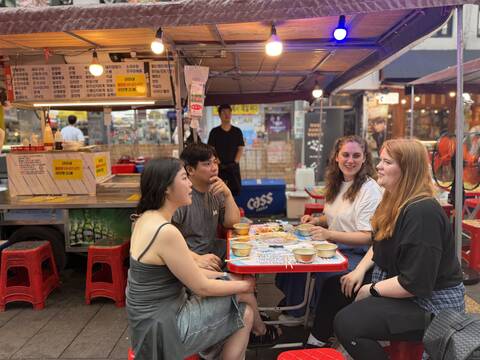
종로 포차거리와 익선동 기념품 투어
Korea's tent-bar street drinking culture, demystified for foreigners. Jongno's pojangmacha alley plus Ikseondong's hanok-lined cafe district by night — the closest cultural substitute for a Korean BBQ + soju tour given the BBQ-tour inventory gap.
- ·The single biggest demystifier on our list for couples and solo travelers entering Korean drinking culture
- ·Jongno pojangmacha alley + Ikseondong hanok lanes — pairs the food/drink with a heritage walk
- ·The closest available substitute for the Korean BBQ + soju + etiquette tour the keymap targeted
- ·Small group format — solo-friendly, no third-wheeling among couples
- ·No reviews yet — newly listed pojangmacha night tour
- ·Alcohol-centric — not for non-drinkers, Muslim travelers, or pregnant travelers. Default to pick #5 or pick #4 instead
- ·Halal: not compliant — pojangmacha culture is alcohol-centered by definition
Best for: Couples on a Seoul date-night arc who specifically wanted a Korean BBQ + soju + nightlife tour and have read our “Honest gaps” callout, and solo travelers anxious about going into a pojangmacha tent alone.
What you’ll experience: A 2-3 hour evening walking tour. The first half is Jongno’s pojangmacha alley — a stretch of street tent bars active from early evening through 2 am. You’ll sit at the communal table with locals, order soju + traditional anju (vegetable jeon, fried chicken cubes, eomuk fish-cake skewers, kimchi pancakes), and the guide walks you through the order-eat-pay-leave rhythm. The second half is Ikseondong — a hanok-lined alley with refurbished traditional courtyard houses turned into cafes, dessert shops, and souvenir stores. The contrast is intentional: gritty tent food + drinking culture, then a heritage-aesthetic nightcap.
The Korean BBQ workaround: No dedicated Korean BBQ + soju + etiquette walkthrough tour exists on MyRealTrip from Seoul currently. Pick #6 is the closest cultural substitute because pojangmacha + soju + traditional snacks shares the cultural register — group eating, alcohol pairing, foreigner-friendly etiquette demystifier. Different format (tent + street snacks vs. indoor grill), same cultural arc. Couples who specifically wanted the indoor-grill BBQ format should configure pick #1 instead.
Alcohol-centric flag: Non-drinkers, Muslim travelers, and pregnant travelers should default to pick #5 (Han River picnic, alcohol-optional) or pick #4 (cooking class, alcohol-free) instead.
Vegetarian reality: Pojangmacha menus often include vegetable jeon, vegetable tteokbokki variants, and kimchi pancakes — vegetarian-adaptable at most stops. Halal not available.
Pairs well with: A daytime cooking class (pick #3 makgeolli, pick #4 generic Korean) — learn the brewing or cooking pedagogy in the afternoon, taste the street version in the evening tent.
7. Itaewon Islamic Street Walking Tour: Halal Korean & Middle-Eastern Food
테마여행신문 : 원코스 서울 이태원 이슬람거리 저자와 떠나는 워킹투어
The only halal-explicit food walking tour in MyRealTrip's current Seoul inventory. Itaewon's Islamic Street — Seoul Central Mosque, halal Korean restaurants, Pakistani / Turkish / Middle-Eastern food crossover — led by a Korean travel author.
- ·Explicit halal-friendly — the only dedicated halal food walking tour on the platform
- ·Vegetarian-friendly: Middle-Eastern cuisine has stronger vegetarian traditions than Korean restaurants (mezze, falafel, vegetable curries)
- ·Author-led walking tour — strong EEAT signal vs. generic operator scripts
- ·Itaewon is Seoul's most foreigner-comfortable district — easy entry for solo travelers anxious about Korean menus
- ·Single review (5.0/1) — small evidence base, but specialty-niche
- ·Not a Korean-food-only tour — Itaewon's Islamic Street is multicultural by design (Korean halal + Pakistani + Turkish + Middle-Eastern)
- ·English narration inferable from the publication-led format, not explicit
Best for: Muslim travelers who need halal-certified food, vegetarian and vegan readers who want stronger plant-based options than typical Korean restaurants offer, and solo travelers who’d rather enter Korean food via the most foreigner-comfortable district in Seoul.
What you’ll experience: A 2-3 hour walking tour through Itaewon’s Islamic Street, anchored on the Seoul Central Mosque (the country’s largest mosque, on a hill above the Islamic Street). The author-led walk covers halal-certified Korean restaurants (yes, halal Korean BBQ exists in Itaewon), Pakistani curry houses, Turkish kebab shops, Middle-Eastern bakeries, and Central Asian dumpling shops. Tasting stops vary by season — typically a halal Korean dish, a Middle-Eastern mezze plate or falafel, and a Pakistani curry.
The halal-explicit moat: This is the only tour on our list with halal-explicit branding, and as far as our keyword searches surfaced, the only halal food walking tour in MyRealTrip’s current Seoul inventory full stop. For Muslim travelers, this single fact moves it from “interesting niche” to “the answer to your search.”
The author-led format: The operator is “테마여행신문 / Theme Travel Newspaper,” a publication that runs author-led themed walking tours. The host is the writer who covered Itaewon’s multicultural food scene for the publication. This is the EEAT signal — you’re walking with someone who reported on this neighborhood, not a contracted bus-tour rep reading a script.
Vegetarian and vegan strength: Middle-Eastern cuisine has centuries of vegetarian tradition (mezze plates, falafel, baba ghanoush, vegetable curries, lentil soups), making this the strongest plant-based-friendly walking tour on our list. If your specific goal is vegetarian or vegan Korean food, pick #1 (private custom) configured for temple cuisine is the more Korean-food-focused answer.
The “not Korean-food-only” caveat: Honest framing — this is a halal-food walking tour through a multicultural neighborhood, not a Korean-food-purist tour. If your goal was specifically Korean food start to finish, configure pick #1 instead.
Honest cons: Single review. Multicultural rather than Korean-food-only. English support inferable from the publication-led format. Past those, this is the only halal-explicit Seoul food walking tour in current inventory.
Pairs well with: A morning Hongdae walking-tour or N Seoul Tower visit — Itaewon’s afternoon pace makes the most sense as the second activity of the day.
Honest gaps — what’s missing from this list
Two structural inventory gaps we want to flag rather than paper over.
Korean BBQ + soju + etiquette tour (the couple gap)
The couples-wanting-Korean-BBQ-night persona is the gap we couldn’t fill cleanly. We searched MyRealTrip’s licensed-guide inventory under “BBQ,” “Korean BBQ Seoul,” “한식 바베큐,” “한식 투어,” “삼겹살 투어,” and “K-Food,” and the dedicated Korean BBQ + soju + etiquette tour does not currently exist in their listings. All BBQ-keyword search results were Dubai, Bohol, or Sydney products that surfaced under noisy keyword matching.
Our workaround: Pick #6 (Jongno Pojangmacha + Ikseondong) is the closest cultural substitute — Korean tent-bar drinking culture with soju + traditional snacks shares the same cultural register, just in tent format rather than indoor grill format.
The honest fix: If you specifically wanted indoor Korean BBQ + soju + etiquette, configure pick #1 (K-Food Private Custom) with this exact request — a private guide can take you to a foreigner-friendly Korean BBQ restaurant in Hongdae, Mapo, or Gangnam, walk you through the cuts and the grill, demonstrate soju etiquette at the table, and stay with you through the meal.
We’ll add a dedicated Korean BBQ + soju tour to this list when one clears our cutoff. Re-validation is October 2026.
Standalone kimchi-making class (the cooking-class gap)
The cooking-class kimchi-making search is a structurally similar gap. We searched under “김치 만들기,” “kimchi class Seoul,” “한식 클래스,” and “Korean cooking class kimchi,” and no dedicated kimchi-only class is currently bookable from Seoul on MyRealTrip. The closest matches are pick #4 (rotating menu, kimchi often featured) and pick #3 (makgeolli, alcohol-paired alternative).
Our workaround: Pick #4 with a “kimchi day requested at booking” caveat. The rotating menu features kimchi as a typical entry; if kimchi is your specific priority, message the operator at booking and confirm a kimchi-day session.
We’ll add a dedicated kimchi-making class to this list when one clears our cutoff. Same October 2026 re-validation.
These two gaps are inventory realities, not curation failures. We’d rather tell you upfront than pretend the list is complete.
All seven at a glance
| Tour | Type | English | Veg | Halal | Alcohol | Price | Rating |
|---|---|---|---|---|---|---|---|
| #1 K-Food Private Custom | Custom | Explicit | Adaptable | Adaptable | Optional | ~KRW 90K | 5.0/3 |
| #2 Gwangjang English Food Tour | Market crawl | Explicit | Partial | Partial | Optional | ~KRW 90K | New |
| #3 Makgeolli + Appetizer Class | Cooking class | Inferable | Partial | No | Yes | ~KRW 65K | 4.8/19 |
| #4 Korean Cooking One-Day | Cooking class | Inferable | Adaptable | Adaptable | No | ~KRW 45K | 5.0/1 |
| #5 Han River Night Picnic | Street/nightlife | Inferable | Partial | Partial | Optional | ~KRW 60K | New |
| #6 Jongno Pojangmacha + Ikseondong | Street/nightlife | Inferable | Partial | No | Yes | ~KRW 70K | New |
| #7 Itaewon Islamic Street Halal | Halal walk | Inferable | Yes | Explicit | No | ~KRW 50K | 5.0/1 |
Filter by your hard constraints first (English requirement, dietary need, alcohol preference, price ceiling), then rank by persona fit and rating-where-available.
FAQ
Is Korean food vegetarian-friendly?
More than the SERP suggests. Banchan side dishes are mostly vegetable, kimchi is primarily cabbage, japchae and bibimbap have vegetarian variants, and sundubu jjigae is regularly made vegetarian on request. The catches are stock and condiments — many soup bases use anchovy or beef stock, many kimchi recipes use fish sauce, shrimp paste sneaks into stews. The fix is asking about stock and substitutions before ordering. On our shortlist, pick #1 (private custom) and pick #7 (Itaewon Islamic Street) are the strongest vegetarian-friendly picks. Pick #4 (Korean cooking class one-day) is the strongest vegetarian cooking class. For solo dining, useful Korean phrases: 채식이에요 (vegetarian), 비건이에요 (vegan), 고기 빼주세요 (no meat), 멸치 육수 안 들어간 거 있어요? (anything without anchovy stock).
Are halal options available in Seoul?
Yes, mainly clustered in Itaewon's Islamic Street near Seoul Central Mosque. Pick #7 in this article is a guided walking tour of that exact neighborhood — halal Korean restaurants, Pakistani curry houses, Turkish kebab shops, Middle-Eastern bakeries. Outside Itaewon, halal options are sparser; pick #1 (private custom) configured with a halal-Korean-restaurants focus is the next-best Korean-food-focused answer. Pick #4 (Korean cooking class) is the halal-adaptable cooking class option (request no pork, no alcohol-cooked sauces at booking). Avoid pick #3 (alcohol-centric makgeolli class) and pick #6 (alcohol-centric pojangmacha).
Are these Korean food tours in English?
Two picks (#1 K-Food Private Custom and #2 Gwangjang English Food Tour) are sold with explicit English-only narration — the guides are hired specifically to lead in English. The other five picks are sold under Seoul-TNA inbound-tourist branding with English support inferable but not explicitly stated — confirm narration language on the booking page before paying. If your group requires native English-only narration with no Korean primary, default to pick #1 (private and configurable) or pick #2 (English-explicit fixed Gwangjang route).
Should I book a Korean BBQ tour or just walk into a restaurant?
Honest answer: there isn't a dedicated Korean BBQ tour on MyRealTrip's Seoul inventory currently — see the 'Honest gaps' section. Two paths if Korean BBQ + soju + etiquette is your specific goal. (1) Configure pick #1 (K-Food Private Custom) as 'Korean BBQ + etiquette walkthrough + soju pairing' — message the operator at booking with this exact request. (2) Walk into a Korean BBQ restaurant in Hongdae, Mapo, or Gangnam yourself — many have English menus, and our 'Korean BBQ + soju etiquette demystifier' section above covers the rituals you'd want a guide for. Pick #6 (Jongno Pojangmacha + Ikseondong) is the closest tour-format substitute if you want the cultural register of Korean meat + soju nightlife in tent format rather than grill format.
How spicy is Korean food really?
Highly variable. Korean food uses two main heat sources: gochugaru (red pepper flakes — bright, building heat) and gochujang (red pepper paste — sweeter, more complex). Some signature dishes are very spicy — buldak (fire chicken), tteokbokki at extra-hot Sinjeon-style chains, kimchi jjigae heavy on gochugaru — but plenty of Korean dishes are mild or medium: bibimbap (mild base, the gochujang on the side is your control), japchae (mostly soy sauce + sesame oil), bulgogi (sweet-savory, no heat), sundubu jjigae (configurable), and most banchan. The 'spicy gauge' in Korean restaurants typically goes 1-5 where 1 is no heat, 3 is medium, and 5 is the buldak threshold. Order 2 if you're heat-sensitive, 3 for adventurous-but-cautious.
What if I have a food allergy reaction during the tour — can I cancel?
Cancellation policies vary by operator, not by platform. MyRealTrip's standard pattern is free cancellation up to 24 or 48 hours before the start time, with partial-refund or no-refund windows beyond that. Mid-tour cancellations due to allergic reactions are typically handled by the operator on a case-by-case basis — most reputable operators will either refund the unused portion or offer a reschedule, but it's not guaranteed. The safer path: disclose all allergies in writing to MyRealTrip's English customer support before booking, not on the morning of the tour. The most common Korean cuisine allergens are shellfish (in kimchi via fermented sauces, in soup bases), peanut (occasional in dipping sauces), gluten (soy sauce, gochujang — both wheat-based unless specified), and dairy. Travel insurance with medical coverage is a reasonable safety net for severe-allergy travelers.
How much does a Korean food tour in Seoul cost?
Across our seven picks, the price band runs KRW 45,000 to KRW 90,000 (roughly USD 33-65). Cooking classes sit at the value end (pick #4 at KRW 45,000) through the mid-tier (pick #3 at KRW 65,000). Walking food tours sit in the mid-tier (pick #2 at KRW 90,000, pick #7 at KRW 50,000). Evening street-food and pojangmacha tours sit in the mid-tier (pick #5 at KRW 60,000, pick #6 at KRW 70,000). Pick #1 (K-Food Private Custom) starts at KRW 90,000 and scales upward depending on add-ons. Premium private combos exist at KRW 500,000+ but we deliberately omitted those. Prices subject to change — confirm on the booking page.
Wrap-up — book with the right expectations
Korean food in Seoul rewards travelers who pick an experience type first and a specific tour second. The seven picks each clear the bar in their own way — pick #1 for foodies stacking multiple experiences, pick #2 for the canonical Gwangjang market crawl in English, pick #3 for the strongest-reviewed cooking class, pick #4 for the alcohol-free kimchi-rotation alternative, pick #5 for the K-drama Han River chimaek scene, pick #6 for the closest Korean BBQ + soju nightlife substitute we could find, and pick #7 for the only halal-explicit walking tour on the platform.
A final note on the gaps: if your specific must-have was a dedicated Korean BBQ + soju tour or a standalone kimchi-making class, the honest answer in May 2026 is that neither currently exists in MyRealTrip’s licensed-guide Seoul inventory. The workarounds (pick #1 configured for BBQ, pick #4 configured with kimchi day) are the most direct substitutes available.
Related reading:
- Best Things to Do in Seoul: 10 Picks for 2026 Travelers — broader Seoul context if you’re still building the rest of the itinerary; Gwangjang Market food tour holds pick #6 in that ranking.
- DMZ Tour from Seoul: Half-Day, Full-Day & JSA Guide — pair a heavy DMZ morning with a Korean food evening; the historical context reframes the food experience and vice versa.
- Ultimate Seoul Travel Guide: Plan Your 2026 Trip — the pillar with neighborhood, transit, and seasonal-timing context (forthcoming).
- 한식 푸드 투어 가이드 (한국어) — Korean-language sister article for residents researching food experiences for visiting friends and family (forthcoming).
Prices and availability subject to change — confirm everything on MyRealTrip’s product pages before you commit. The two structural gaps (Korean BBQ + soju tour, standalone kimchi-making class) are flagged in “Honest gaps” above and re-validated on every article refresh.